📏 Standard Work: the key to producing better, with fewer errors and greater peace of mind.
Nov 18, 2025
🔧 Too often overlooked, Stadard work is actually the key to producing better with fewer errors. Find out why… and especially how to implement it effectively.
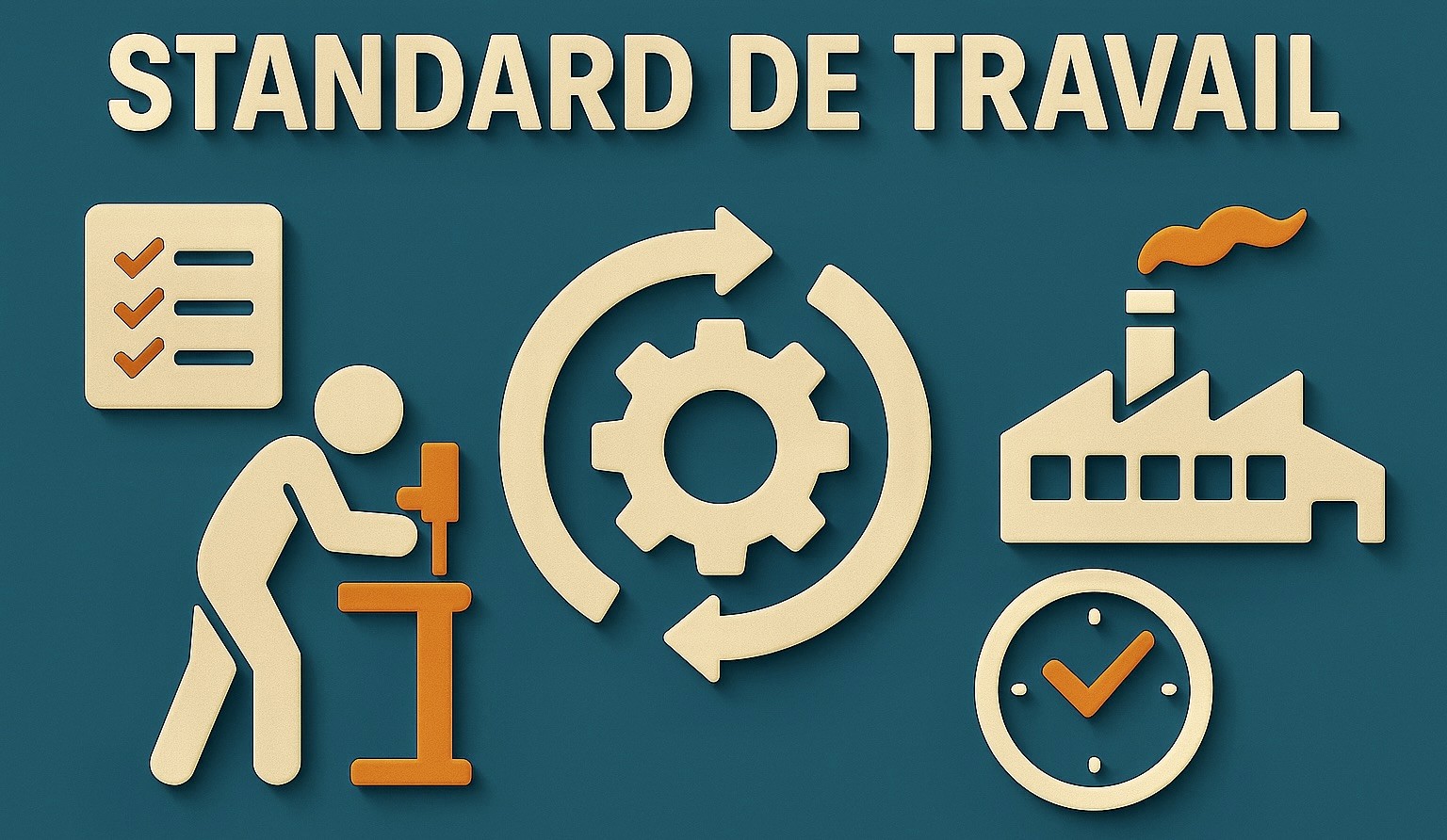
In many industrial workshops, you often hear:
"Everyone does it their own way"
"You have to ask Jean, he’s the only one who knows how to do it"
"Mistakes? Well, it happens."
What if we moved from random execution to a structured, safe, smooth, and almost predictable environment?
Welcome to the world of Standard Work: a powerful tool, but too often ignored, that fundamentally transforms the way we produce on a daily basis.
🔍 Why it matters, especially in an industrial SME
In an SME, resources are limited, teams are often multi-tasking, and every mistake is costly. Too much variability in how the same task is performed leads to:
❌ Increased risk of errors or non-conformities
⏳ Wasted time during restarts or onboarding
🤔 Quality that depends on the “star operator” rather than the process itself
Implementing Standard Work means:
Laying the foundations of quality and performance
Securing actions and transferring knowledge
Providing a concrete lever for continuous improvement
It’s just like a proven recipe:
Everyone knows what to do, how, and with what expected result.
And when the recipe is good, we keep it, we improve it…
But we don't reinvent it every time.
📊 Standard Work explained simply (and practically)
Standard Work is not an administrative document or a 48-page manual.
It’s a clear, visual, and shared synthesis of the best-known way to perform a task today.
📍 Example: tool change on a press
Currently, depending on the operator, the sequence varies. The order of checks changes. Sometimes, tightening is forgotten.
🔻 Consequences? Downtime, rejected parts, safety scares.
✅ With a standard work:
Each step is described simply
A diagram or photo illustrates the action, the tool, the order
The key safety and quality points are highlighted
The document is displayed at the workstation, at eye level
And above all: it is co-constructed with the operators.
👉 It showcases their know-how, not a procedure imposed from an office.
📘 How to implement effective Standard Work
Here’s a simple, concrete, and proven method in many companies:
🔄 Step 1: Identify key processes
Focus on 3 to 5 critical areas: recurring defects, human errors, unexplained stoppages.
Involve operators, supervisors, quality, maintenance.
📸 Step 2: Observe with a Gemba Walk
Go see. Observe the actual actions.
Note the variations, inconsistencies, micro-wastes.
📝 Step 3: Build the standard
Map the process (SIPOC, flowchart, steps)
Write clear instructions, with pictograms, photos, critical points
Add a standard work form if necessary (time, position, checks)
📈 Step 4: Test, adjust, validate
Test with a volunteer operator
Adjust unclear sections
Get team agreement on the final version
📍 Step 5: Display and keep it alive
Display at the workstation (laminated, QR code, simple format)
Integrate the standard into rituals: "Is it still useful, applied, clear?"
🧰 Tools & indicators to monitor deployment
Useful tools:
Gemba or Kaizen events to identify needs
Standardized Work Instructions (SWI)
Training Within Industry (TWI)
Document management and version tracking
Indicators to follow (examples):
⏱ Cycle time
📉 Defect rate
⚠️ Non-conformities
🧩 Conclusion: One small standard, one big step
Standard Work is not just another document.
It’s a framework for control, a collective reference, a real lever for continuous improvement.
And above all, it’s a simple tool that any SME can put in place starting today.
What is the first position you will standardize this week? 📋 Launch a small pilot project. Test. Adjust. Capitalize.
Because real improvement always starts with a clear starting point. And a good standard is exactly that: a solid foundation. 💪